The Dewey Decimal Classification System
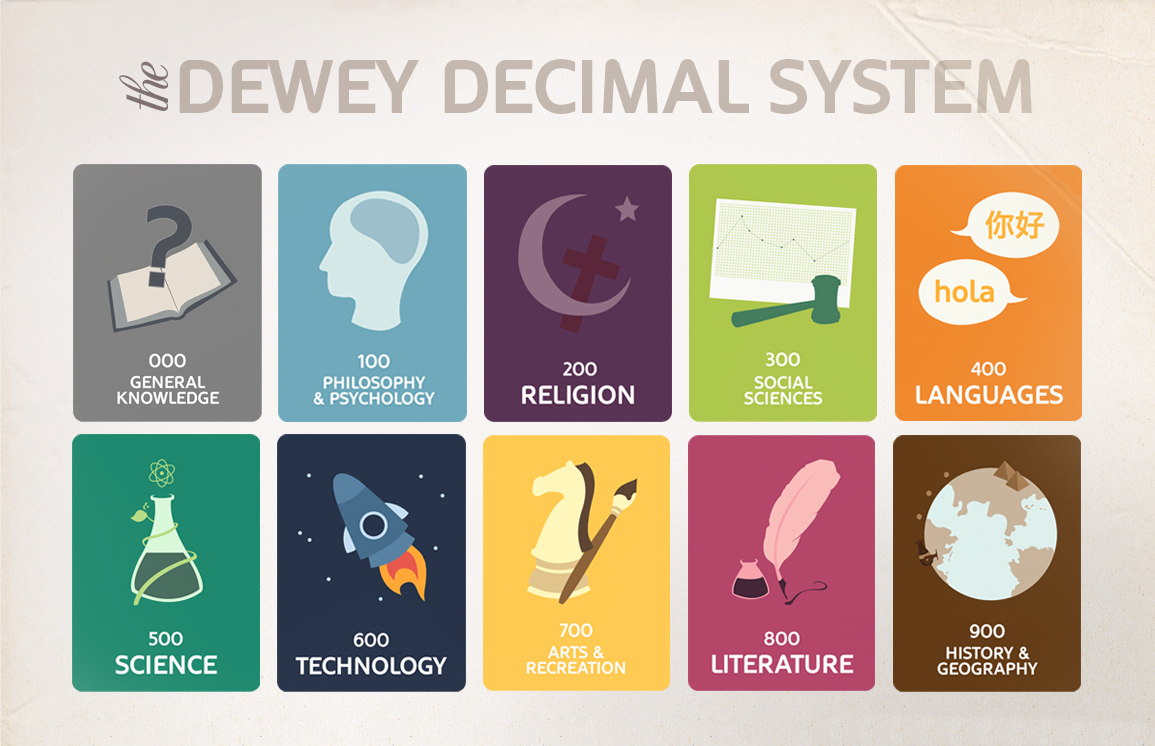
The Dewey Decimal Classification System is the most widely used method for classifying books via subject in a library, was create by Melvil Dewey in 1876. Each book is issued a shelfmark number, on the spine of the book, and arranged in numerical order. Each subject is represented by figures beginning with 000 and going on to 999. After the three digits there is a decimal point and numbers after the decimal point show the sub-section of the subject area. After the numbers there are three letters which refer to the author of the book and are in alphabetical order and always the three first letters of the author name.
for example:

001.352HER –> 001 Computer science –> 352 Programming OOP –> HER Herbert Schildt
002.353MIK –>002 Computer science –> 353 Sockets –> MIK Mike Josnowski
645.299JOH –>645 Technology –> 299 Manufacturing –>JOH John Adams
Because of the rapid expansion of internet, users unintentionally created an alternative way to classify information using tags, is the Folksonomy and its refers to a classification of data in which users use tags to information objects like Photographs, web pages, texts, videos, etc, so a Folksomomies arise when several users collaborate in the description of the same informative material.
To classify information in this way could have some lack of terminological control because some users could tag with wrong spelling and the same tags for different objects decreasing the efficiency of content search, but also could have some advantages because this simple to search about one specific topic in a short time and is the easiest way to classify information quickly. some examples of webs-site that they use Folksonomies are Flicker, Youtube or del.icio.us.









Publicar comentario