The most important internet protocols


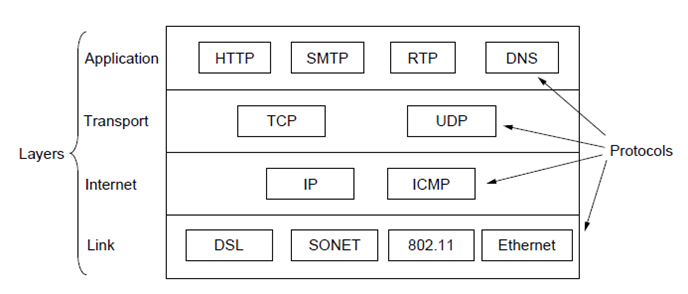
Protocols are defined as a set of rules and guidelines put in place to achieve a standard. In communication and internet architecture a protocol refers to the rules and standards set out to allow for standardized communication across countries, hardware manufacturers, software manufacturers and network types. Without protocols in place it would be possible for each country, hardware and software manufacturer to create their own rules of communication and therefore have no ability to communicate across digital borders (at least not without complex “translation” tools). Therefore, having a set of protocols for communication allows the internet to exist globally, with every stakeholder following a single set of standards and rules for communication.
HTTP
HTTP (Hyper Text Transfer Protocol): This protocol is the mainstay of the World Wide Web and is used to exchange information by defining how the information should be organised and transferred. If you look at a typical URI, such as http://www.google.co.uk you will notice HTTP is prefixed onto the address of the website. This means that if you were to enter the above URI into your browsers address bar, a HTTP request would be made and sent to the IP relating to www.google.co.uk. Googles server would then process your HTTP request and send back a HTTP response, in this case Googles homepage.
FTP
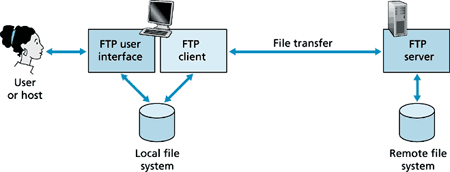
FTP (File Transfer Protocol): A protocol that defines how to transfer files from one computer to another. An FTP server and an FTP client are usually needed, where the FTP server is hosted where we have our web hosting and we access the files through the FTP client one of the most used clients is FileZilla FTP client.
IMAP
IMAP (Internet Message Access Protocol): This protocol is one linked to accessing your emails and allows your email client to download your emails from an email server. What makes this protocol different from other email protocol such as POP (Post Office Protocol) is that your email messages remain on the email server after you have downloaded them, unlike POP which would delete them from the email server after the download was complete.
ARP
ARP (Address Resolution Protocol: This protocol manages to find the MAC hardware address that corresponds to a specific IP address. There is a RARP protocol, whose function is the reverse, which manages to find an IP address corresponding to a MAC hardware address.
TCP
TCP (Transmission Control Protocol): This protocol is the backbone of the internet and provides a method for creating and maintaining a connection between devices to allow for communication. It is a connection oriented protocol which is often referred to as a reliable connection as the protocol attempts to ensure error free transmission. TCP achieves this error free transmission by breaking down the data into packets, ordering them and ensuring flow control is used by acknowledging what packets have been received and in what order. If the packets are received out of order due to a packet being lost or using a slow route to the destination or the packet is corrupted, then the destination device requests the packet again from the sender. While this adds protection mechanisms for error free transmission it also increases latency and means that it can longer to send and receive the data because of the rules used in the protocol. It is because of this error free connection that TCP is used as the backbone of the internet.

UDP
UDP – User Datagram Protocol. This protocol is a popular alternative of TCP and provides a method for creating a connection between devices to allow for communication. It is a connectionless oriented protocol and is therefore not a reliable method of sending data because the protocol does not have a method or rule defining what should happen if packets of data arrive in an incorrect order, are lost or are corrupted after the transmission.
Bitcoin
Bitcoin is an open source protocol where users can make transactions between them without having to resort to third parties, the currency used is bitcoin and is not backed by any government, therefore it is a decentralized currency and the transactions are supported by computers called miners that make transactions possible and receive a payment for each blockchain decrypted.
IP v4 v6
IP v4 v6 (Internet Protocol, version 4 and version 6). TCP and UDP may provide the rules for transmission but they do not provide the method on addressing all the devices on the network. It is all well and good using IMAP for your emails and using TCP to break the data from those emails down but where is the data meant to go? This is where Internet Protocol (IP) comes in. By attaching the senders IP address and the receivers IP address, unique numerical numbers used to identify networks and devices, to each packet before being sent into the internet the packet can be forwarded on until it reaches its destination.









Publicar comentario