The differences between URN’s and URI’s
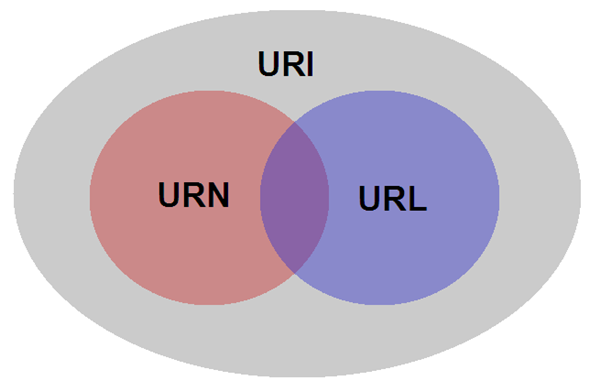
Uniform resource locator (URL). It is the sequence of characters that follows a standard and that allows the use of the internal resources of the Internet environment so that they can be located.
Text documents, photographs and videos, among other types of digital content, have URLs when they are published on the Internet. Locators allow you to create hyperlinks on the World Wide Web, which facilitates navigation.
The URL is, therefore, the set of characters that allows the assignment of an exclusive address to a resource that is available in the virtual space. In other words, the URL is an Internet address that, when it is found and viewed by a browser, shows an information resource to the user.
Uniform Resource Identifier (URI) is a string of characters used to identify a name or a resource on the Internet
A URI identifies a resource either by location, or a name, or both. A URI has two specializations known as URL and URN
A Uniform Resource Name (URN) is a Uniform Resource Identifier (URI) that uses the URN scheme, and does not imply availability of the identified resource. Both URNs (names) and URLs (locators) are URIs, and a particular URI may be both a name and a locator at the same time.
The URNs are part of a larger Internet information architecture which is composed of URNs, URCs and URLs.
A Uniform Resource Characteristic (URC) provides a set of attribute/value pairs used to describe URIs: authorship, publishers, copyright, etc. No proposed standard has been submitted yet.
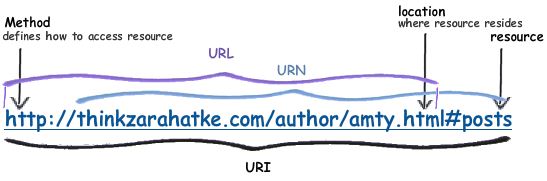
URN Example:
urn:isbn:0451450523 to identify a book by its ISBN number.
urn:uuid:6e8bc430-9c3a-11d9-9669-0800200c9a66 a globally unique identifier
urn:publishing:book – An XML namespace that identifies the document as a type of book.
URI Example:
http://www.w3.org/TR/html4/strict.dtd







Publicar comentario